A 'rom-com' is a shortened term for the genre of films classified as Romantic-Comedies.
A rom-com is generally any sort of filmed production with a light hearted, funny storyline centred around a secondary romantic plot as well. These films generally focus around the main couples whose relationship we vouch for by the end, but its not unknown for a film to include more characters as the centre focus; i.e 'Bridget Jones Diary' includes 2 romantic interests for the protagonist, and in '10 Things I hate About You' the film actually focuses around the story of 2 (sort of 3) pairings and their romantic stories.
 |
| The rowboat trope used in 'Enchanted' |
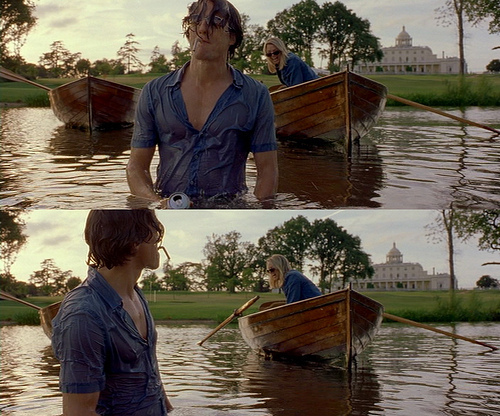 |
| The rowboat trope in 'Bridget Jones Diary' |
These are one of the reasons films can have multiple genres as when using multiple tropes from different genres, it can be difficult to place it wholeheartedly into one genre. To illustrate this point better there is one trope that's older than most, but immediately recognisable as a romantic trope, the Old-Fashioned Rowboat date, which is defined by tvtropes.org as follows: "A lady and her suitor are having a romantic date on a rowboat. This was a popular dating image for the 19th and early 20th century upper classes, as it provided a chance for couples to be alone together, but still in plain sight to avoid accusations of anything sexual happening".
Other common tropes are: 'The False Soulmate' (the pre-existing relationship between one of the protagonists and another character that's, although strong, is destined to fail), The main pairing just bumping into each other at random places completely by coincidence, proof of love by grand romantic gestures, the 'just friends' pair who are good pals, but clearly seriously infatuated with each other, and most clearly, the confession itself is a massively, important trope that generally finalises each romantic film. This is just a tiny handful of tropes, the list goes on to easily over 200 tropes in the romance genre alone. The inclusion of multiples of these tropes is what classifies a romance film into this genre. It also explains why films such as Kick-Ass, Keeping Mum, and Sherlock class as romantic productions despite them being best known for being largely associated with another genre. This is in all serious as well, for example, someone cross matched BBCs Sherlock, a nearly exclusive crime drama show, with 157 romance tropes that appear in throughout the first 3 season despite its classification.
 |
| The held gaze trope |
-the held gaze (where the main couple just keep staring at one another)
-love hurts (where their feelings for eachother lead to emotional, and sometimes physical pain)
-the love triangle (where an obvious 3rd-wheeling characters gets in the way of the main relationship)
-'Love will lead you back' (where no matter how far apart they end up, they are always drawn back to each other)
-'Fate will lead you back' (Where no matter how far they purposefully try to get away from each other, fate just keeps bumping them back together).
This basically illustrates how versatile tropes are and how much we depend on them
heres the list.
Another strong aspect of a rom com is the way its shot and edited. Although this obviously differs from director to director, but a general theme has formed as is pretty easy to distinguish from other genres.
 |
| Screen cap from horror show 'Supernatural' |
For example, horror films are almost guaranteed to have the severely contrasted, dark lighting to induce fear, and tension visually which is normally heightened with the addition of sound. Whereas, in a romantic film the lighting is generally very soft, with few shadows, and very warm colours. This generally makes viewers feel relaxed and happy, a requirement for lighthearted films.
 |
| Screen cap from Romeo and Juliet |
This is easily one of the most important dividers in genres as without the dialogue, because as long as its shot in the general warm and inviting manner, you could take away the sound the fact its a romantic film because immediately recognisable.
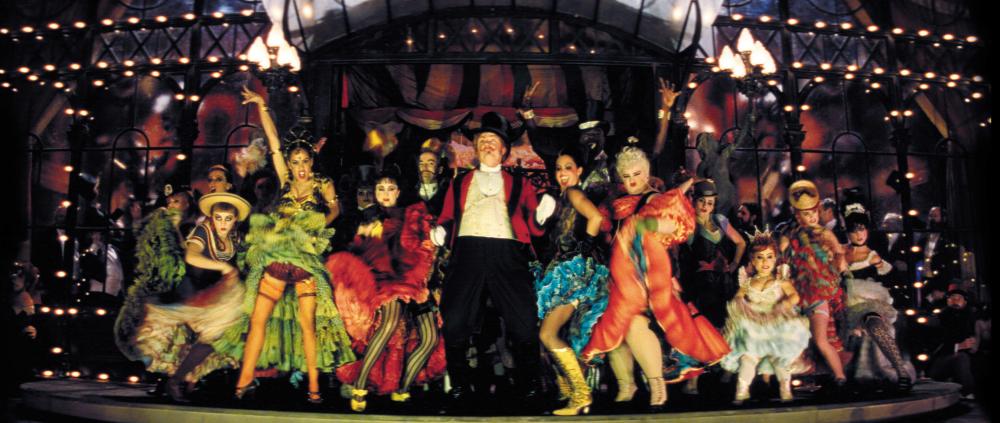 |
| The first number introducing the Moulin Rouge |
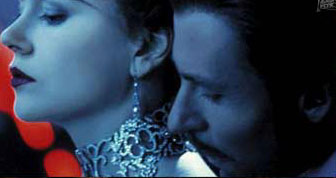 Later on in the film we see Satine (our leading lady) forced to betray her love for Christian for the money to save the Moulin Rouge, and the entire scene in filmed with blue lighting and dark shadows which I think is great way to visually illustrate how cold she feels at this crucial turning point in the film.
 The final point of interest for me is the very last shot when Satine, overcome by her long term illness, dies onstage after her final performance in the arms of Christian. What I adore about this shot is how the colours go from the saturated, joyful colour pallette, to this really dingy, pale, beige colour set. Turning from these fantastic colours to this realistic, depressing, and sobering ones instead is such a blindingly good visual metaphor for Christian realising the love of his life is dying.
Using colour in such a discreet manner to bring across emotion is one of the best tools used by modern filmmakers today, especially in the context of a romance film which rests its weight almost entirely on the emotions that come across during it.
In conclusion, seeing how films can be associated with genres more predominantly than others gave me some interesting ideas, now I know that not all rom-coms are focused solely on the the romance and, as long as its apparent to be a romance in the trailer, my film can be based around any plot line. Which is very helpful in generating ideas. Also, in the way of style, looking into the usage of lighting in the contex of subtextual storytelling is a really interesting idea I would like to work with in my own production.

No comments:
Post a Comment